Office lighting: what you need and why
Good office lighting lets people read and use screens without squinting or glare. It is a mix of daylight, even ceiling light and a little task light where needed. Here are the levels to aim for and simple ideas for difficult rooms.
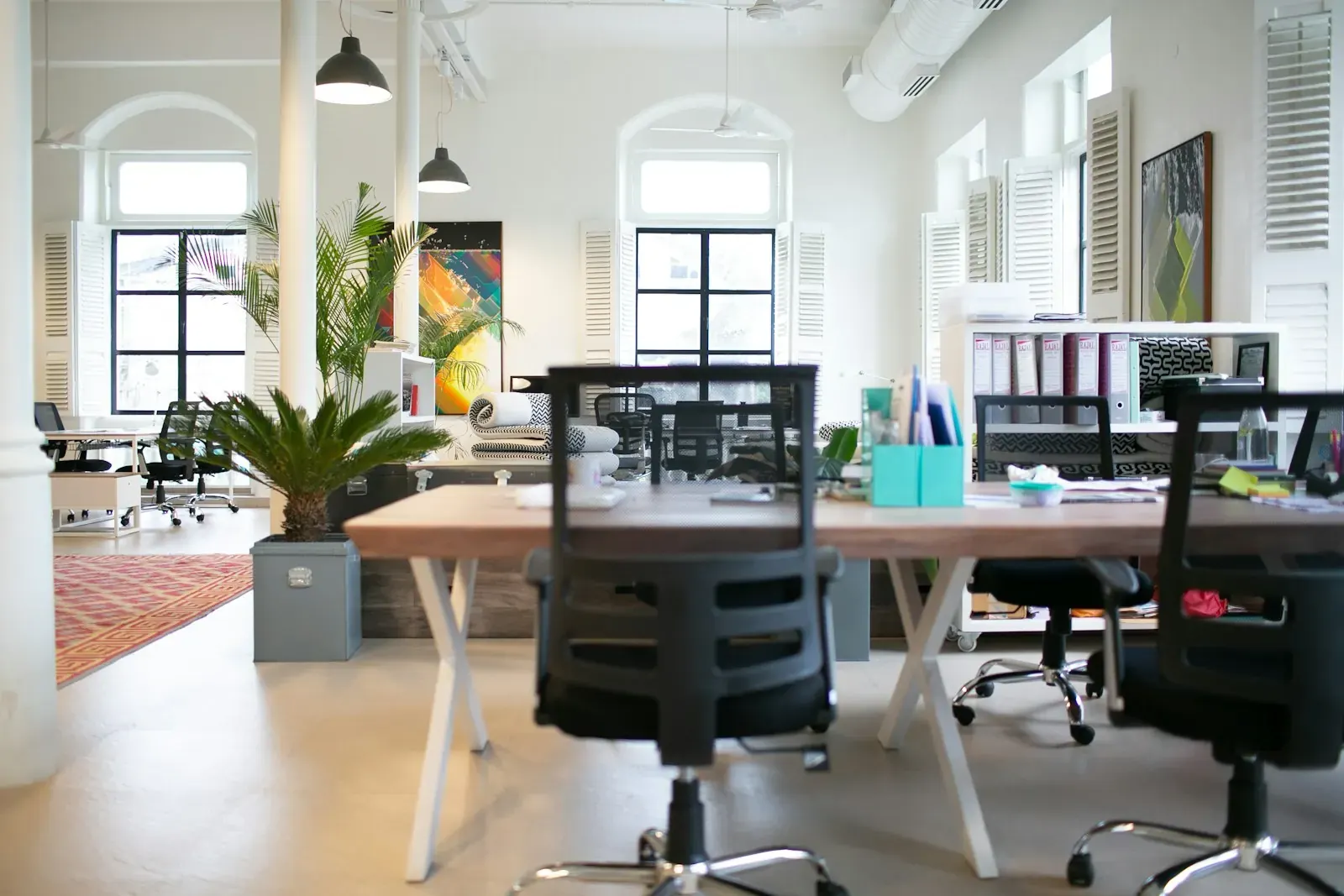
Recommended light levels for office work
Light on a work surface is measured in lux (lumens per square metre). One foot-candle is about 10.76 lux.
| Activity | At the work area | General room light |
|---|---|---|
| Normal office work (reading, writing, screens) | 500 lux | 300 lux |
| CAD workstations | 500 lux | 300 lux |
| Work with higher demands on vision | 750 lux | 300 lux |
| Archiving and copying | 300 lux | 200 lux |
Source: Swedish Work Environment Authority (Arbetsmiljöverket) guidance on office lighting, which refers to the European standard EN 12464-1:2021 for indoor workplace lighting. These are minimum figures.
In the US, designers use the Illuminating Engineering Society (IES) recommended practice for offices, which also sets targets by task. In the UK, HSE's workplace rules ask for suitable and sufficient lighting, and where possible natural light (ACOP L24, regulation 8).
A light meter app on a phone gives a rough reading. For a proper check, ask an electrician or lighting designer to measure.
Lighting for computer use
- Avoid bright lights or windows directly behind or in front of the screen.
- Place screens at right angles to windows. OSHA's workstation guidance recommends this to cut glare.
- Tilt the screen so it is square to your line of sight. OSHA notes that a screen tilted back can catch glare from overhead lights.
- Use blinds to control low sun.
- Choose ceiling fittings with diffusers, so you cannot see the bare light source.
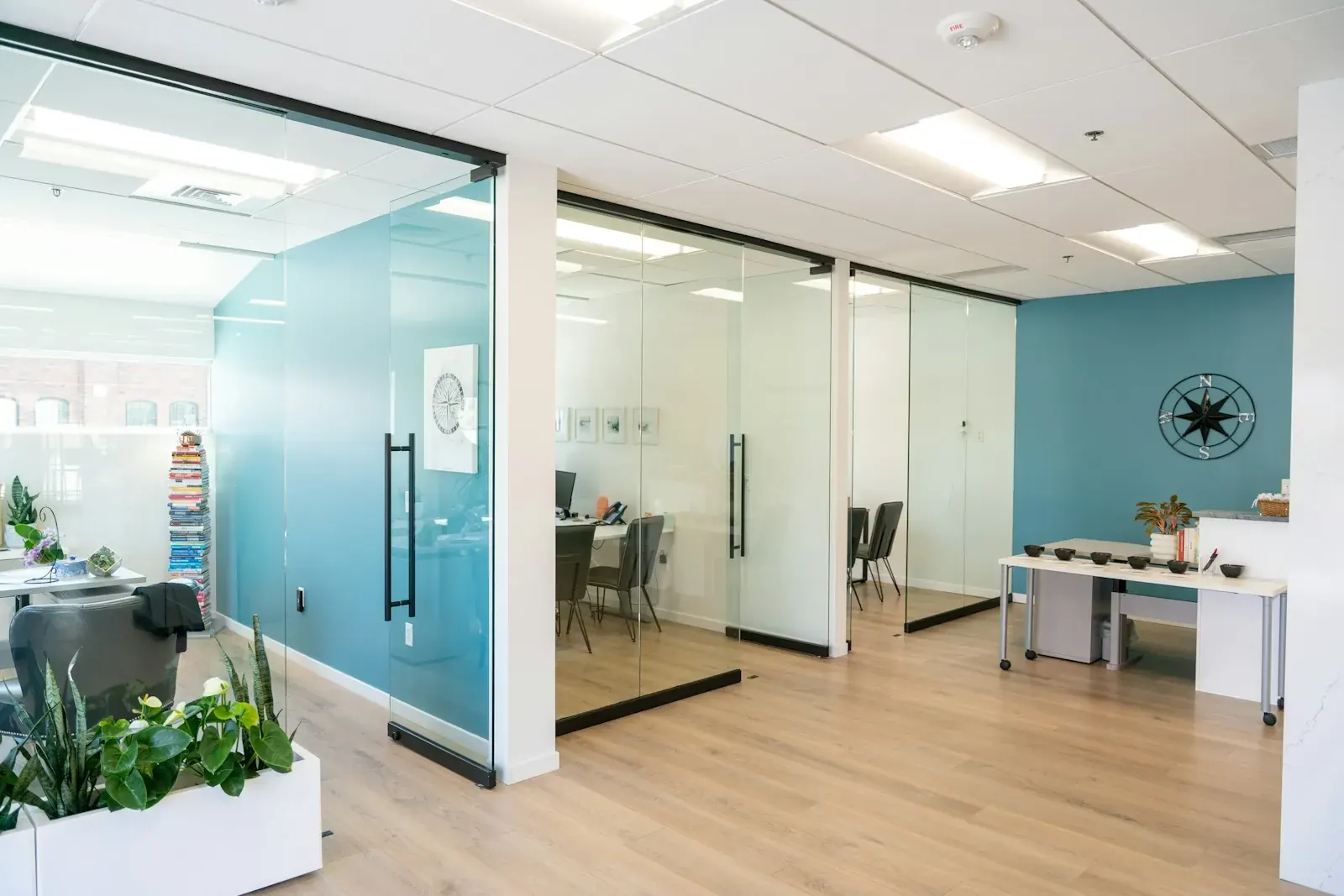
Best lighting for an office with windows
- Put desks near windows, side-on to the glass.
- Use light-coloured walls and ceilings to bounce daylight deeper into the room.
- Add daylight sensors so ceiling lights dim when the sun is strong.
- Keep tall furniture and high cubicle panels away from the window wall.
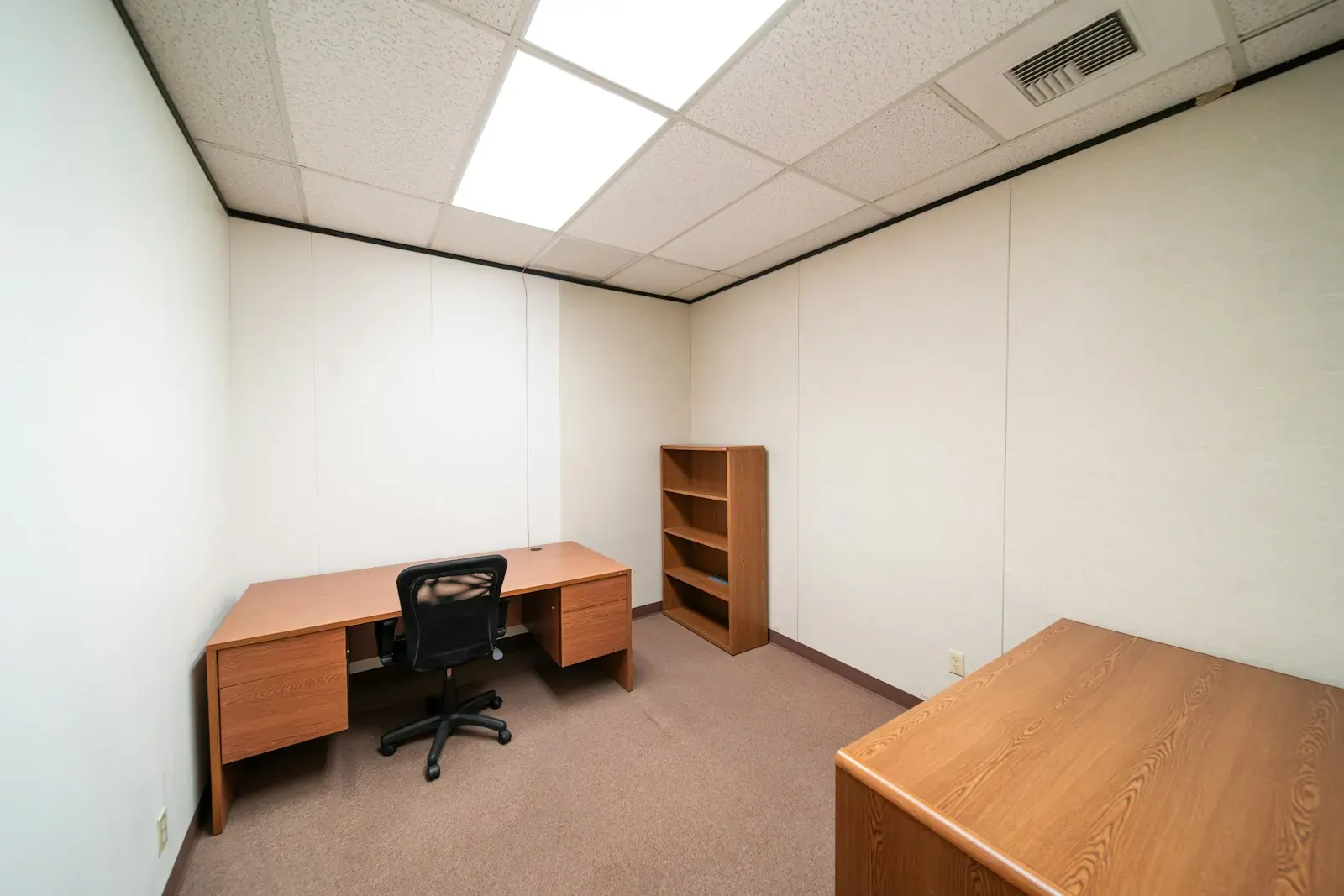
Lighting ideas for an office with no windows
- Use even ceiling light across the whole room, not just over desks.
- Light the walls with wall washers or uplights. Bright walls make a room feel larger and less closed.
- Choose a neutral to warm white (around 3000 to 4000 K) for a calmer feel.
- Add a desk lamp for each person, so they can adjust their own light.
- See our small office ideas for decorating a room with no windows.
Office lighting for video calls
- Face a window or a soft light. Light from in front evens out your face.
- Avoid a bright window behind you; it turns you into a silhouette.
- A small light at eye level, behind the screen, lifts shadows. Bounce it off a wall if it is too harsh.
- Use the same colour of light everywhere in view, so the camera does not mix warm and cool tones.
Office lighting without a false ceiling
If you have a concrete or exposed ceiling, with no drop ceiling to hold recessed fittings:
- Use suspended linear fittings hung on cables. They light both down and up.
- Use surface-mounted panels fixed directly to the ceiling.
- Run track lighting for flexible spotlights over displays.
- Add floor-standing uplights near desks if there is no power in the ceiling.
Energy and fittings
LED fittings use less energy than older fluorescent tubes. ENERGY STAR lists certified light fixtures for the US. Fit motion sensors in meeting rooms, washrooms and storerooms, so lights switch off when no one is there.
Frequently asked questions
What is the correct lighting level for an office?
For normal office work, guidance based on the European standard EN 12464-1 asks for at least 500 lux at the work area and 300 lux in the room in general. Archiving and copying areas can be lower.
What are the office lighting requirements in the US?
There is no single federal lux rule for offices. Designers follow the IES recommended practice and local energy codes. OSHA's workstation guidance covers glare and screen position.
How do I light an office with no windows?
Use even ceiling light, light the walls, choose a neutral to warm white and give each person a desk lamp.
What is the best lighting for video calls?
Soft light from in front of you, such as a window or a lamp behind the screen. Avoid a bright window behind you.
Where should a desk go in relation to the window?
Side-on, so the window is to your left or right. That cuts glare on the screen.